

It’s not a mid-life crisis. It’s not a pandemic phase. The data says it’s a permanent shift — and for a growing number of Sydney families, the Hunter Valley is where it leads.
Ask someone who’s already made the move what finally tipped them and they’ll rarely point to a single moment. It was the school pickup squeezed into 40 minutes of bumper-to-bumper traffic. It was the backyard that never felt big enough. It was the Sunday afternoon scrolling through Domain, looking at properties with space and thinking: that could be us.
The tree change, it’s the decision to leave a major capital city for a life with more space, more quiet, and more intention. This is not new, has been a feature of Australian culture for decades. Our parents generation tended to come from the country or have that one uncle that had a farm that we were able to go once a year to visit.
But something has shifted in the last few years. What used to be a retirement plan is now a decision being made by families in their mid-thirties.
What used to mean giving things up now, increasingly, means getting things back.
You may know of families or friends who hastily bought into a regional area in covid thinking that it was a way to get out of the city and lockdowns, only to be regretting their choice three years later and returning to the city or suburbs as it was too much of one or the other.
Maybe they were right to make that decision, but the urgency of that move at a time of crisis, didn’t give them the options to make better choices. Choices that with some hindsight could mean a move to an area that could give their life the best of both worlds. Close to major centres but not too far from Sydney that it feels impossible to commute.
The numbers behind the shift

Regional NSW has seen sustained population growth from Sydney-origin families since 2020. The Hunter Region is among the top three internal migration destinations in the state, not because of affordability alone, but because of what it offers in exchange for what you’re leaving behind.
The average Sydney house price-to-income ratio now sits above 12:1. The median Sydney house price has crossed $1.5 million. For a family already paying that for a three-bedroom house on a 400-square-metre block, the mathematics of a two-to-five acre lot in the Hunter Valley, at a fraction of the price, seems like a no brainer.
Not as a downgrade. As a trade-up in the things that actually matter.
You don’t sacrifice Sydney. You stop paying for things you never really had.
What families are really looking for

In conversations with buyers who’ve registered interest in acreage estates across the Hunter Valley, a few themes emerge consistently. Not the features, the feelings.
The shed. Almost every family who moves to acreage mentions the shed unprompted. A proper shed. A shed for the car, the tools, the trailer, the kayaks. A shed that isn’t wedged between the fence and the neighbour’s garage. In Sydney, a shed is a luxury. On a two-acre block, it’s just Tuesday.
Room for animals. Not a farm, a few chickens, maybe a dog that can run, possibly a couple of sheep for the kids. The suburban dream of backyard animals is perpetually deferred in Sydney. On an acreage block it’s the first thing people plan.
Mornings. This one is harder to explain in a property listing, but buyers talk about it often. A morning where the first sound you hear isn’t a neighbour’s air conditioner or the bin truck. A morning where the view from the kitchen window isn’t another wall.

Space to breath. Another hard one to explain until you have it. It’s the feeling you have when you stay at a Airbnb in the country. You have your space, your gardens and taking a walk to your vegetable garden though your backyard feels akin to the walking in your own park.
Why the Hunter Valley specifically
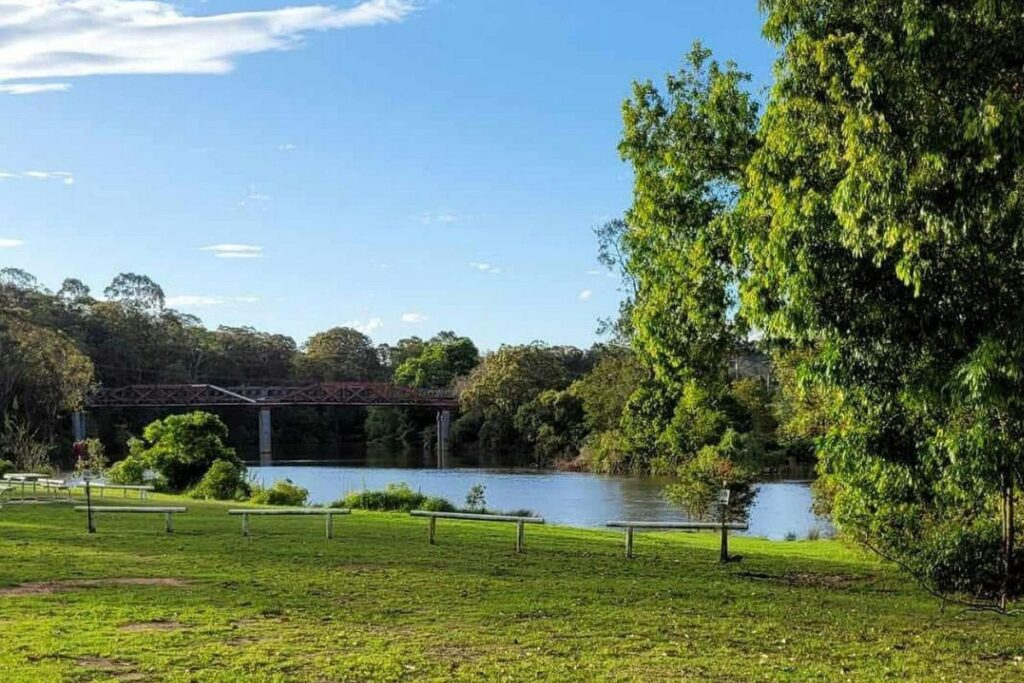
NSW has several regional corridors attracting Sydney tree-changers: the Southern Highlands, the Central Coast, the Mid North Coast, the Blue Mountains fringe. Each has its appeal. But the Hunter Valley has a combination of factors that makes it particularly compelling for families, as opposed to empty-nesters or retirees.
Distance. The Hunter Valley is genuinely two hours from Sydney’s CBD via the Pacific Highway and Hunter Expressway, on a Sunday afternoon, not a Tuesday at 6am. For a family where one or both parents work hybrid — two or three days in the city, this is a manageable weekly commute, not a life overhaul.
Infrastructure. The $470 million new Maitland Hospital opened recently, representing one of the most significant public health investments in regional NSW in decades. The Hunter Expressway connects the region to Newcastle quickly. NBN is broadly available. These are not small matters for families choosing a permanent home.
Schools. Maitland and Newcastle have extensive schooling options, including well-regarded public and private secondary schools. For primary-aged children, local community schools in townships like Clarence Town are small, genuinely community-rooted.
Community. This is the one that surprises people most. The Hunter Valley’s townships including Clarence Town, Dungog, Paterson, Morpeth, all have active, genuine community life. Sport clubs, school fetes, local markets, families who’ve lived next to each other for three generations. You can’t buy this in a new suburb. But you can move into it.
The hybrid worker reality

The pandemic didn’t create the tree change trend, but it fundamentally changed its feasibility. A Sydney professional who works from home Monday, Wednesday, and Friday has a commute that looks very different to their parents’ generation. The two-hour drive to the city becomes a twice-weekly event, not a daily grind.
For this buyer, and they are the fastest-growing segment of acreage enquirers in the Hunter Valley, the question isn’t whether they can afford to leave Sydney. It’s whether their internet connection is fast enough to stay.
At Mill Rise Estate in Clarence Town, the answer is yes. NBN is available, and the underground power infrastructure means connectivity is reliable.
The morning commute is now the walk from the back deck to the home office. The afternoon one is across the paddock to check on the chickens.
What the move actually looks like
For most families, the tree change happens in stages. The first stage is permission. Giving yourself permission to seriously consider it.
The second is research: drive times, schools, NBN, medical. The third is a visit, driving out on a Saturday, walking a block, standing on an elevated lot and looking across the valley at nine in the morning.
The fourth stage, for most people, is the hardest: letting go of the idea that living two hours from Sydney is somehow a lesser choice. It isn’t. For a growing number of families, it’s the better one.
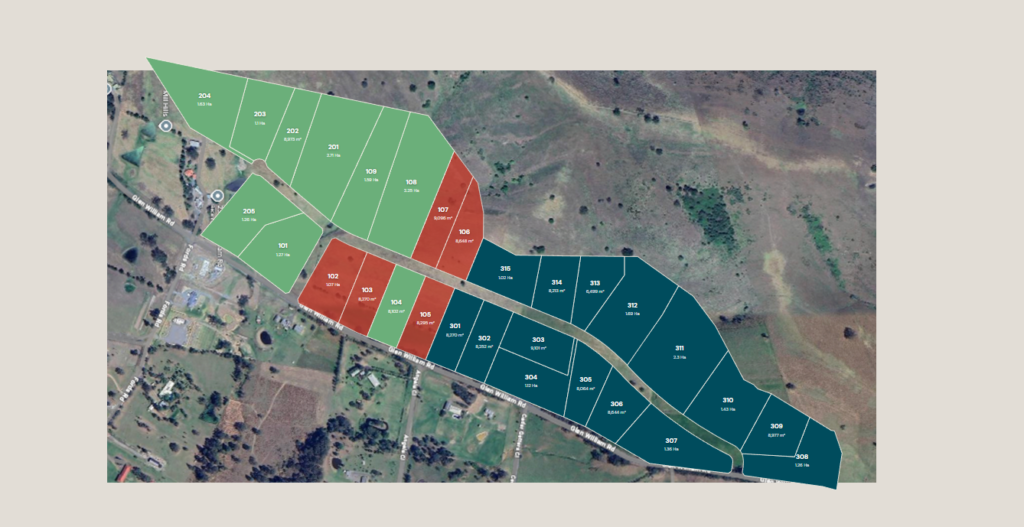
Mill Rise Estate sits at 231 Glen William Road, Clarence Town, minutes from the Williams River, easy reach of Maitland and Newcastle, and about two hours from Sydney’s CBD. Lots range from two to five acres, starting from $600,000, with access to underground power, access to NBN, and flexible deposit and settlement options for approved purchasers. Registration is expected late-June 2026.
Is it right for your family?
The tree change suits families who work hybrid or have workplace flexibility for at least part of the week. It suits families with primary-aged children, or no children yet, more readily than those with teenagers already embedded in Sydney schools and social networks. It suits people who genuinely want space, not as a concept, but as a daily reality.
It doesn’t suit everyone. If your career requires five days a week in a Sydney CBD office, the two-hour commute each way is not manageable. If your extended family network is deeply Sydney-based and important to your daily life, distance matters. These are honest considerations, and any good developer will tell you so.
But for families where those conditions aren’t constraints, and there are more of them every year, the Hunter Valley tree change is increasingly not a dream. It’s a plan.
Register your interest in Mill Rise Estate
Stage 2 has just opened.
Want more information; Register your interest here: Mill Rise Estate Page.
Ready for Inspection; Contact our agents
Tavis Chivers at Dillon & Sons Dungog on 0428 921 704, or Scott Hunter at Ray White Rural Lifestyle Sydney on 0448 870 068.